For a century, manufacturing companies like Festo built their identity around engineering excellence, precision pneumatics, hydraulic systems, and mechanical innovation. Software wasn't their world. That assumption is dead.
Today, the world's leading industrial organizations are becoming software-driven enterprises. And the epicenter of this transformation isn't Silicon Valley, it's their Global Capability Centers in India. These centers, once perceived as cost-reduction hubs, have quietly become innovation engines where AI, cybersecurity, embedded systems, and digital design converge to solve complex manufacturing challenges.
The numbers validate what's happening: the GCC AI manufacturing market is projected to grow from $98.64 billion in 2024 to $1.33 trillion by 2035, a 26.69% CAGR that reflects structural, not marginal, change.
But here's what matters most: manufacturing organizations are no longer hiring people to process data. They're hiring AI researchers, embedded systems engineers, and cybersecurity specialists, the same talent pipelines that tech companies compete for. And they're winning that competition because they're offering something different: purpose.
How are the Core Sectoral GCCs transforming? Three visible dimensions of change:
AI Has Moved from the Cloud to the Device
Traditional GCCs processed data centrally. Now, edge AI is embedded in devices, AI running directly on industrial equipment, not dependent on cloud connectivity.
Practically: sensors that predict equipment failure in real time, cameras that detect defects in milliseconds, and control systems that adapt to production variables instantly. This requires a rare skill set: deep electronics knowledge plus machine learning expertise. The benefit is immediate and measurable: fewer production stoppages, less waste, faster quality response.
Software Is Now Core to Product Differentiation
Industrial companies historically viewed software as a cost center. Now it's the core strategy.
Manufacturing GCCs are building IoT platforms, cybersecurity systems for industrial devices, and smart automation, work that directly differentiates products and creates customer value. With 83% of GCCs scaling GenAI and 87% taking ownership of end-to-end global processes, the shift from cost center to value creator is unmistakable.
The Talent Model Has Inverted
Manufacturing GCCs no longer compete on cost. They compete on meaning.
You can't fill an embedded AI role by offering 10% cheaper salaries. You need engineers who see industrial AI as a frontier worth exploring. More than 77% of manufacturers have implemented AI; the question now is whether you have the people to build the next generation.
The Podcast Conversation: Insights from a Manufacturing Leader at the Forefront of AI Innovation & Core Business Transformation
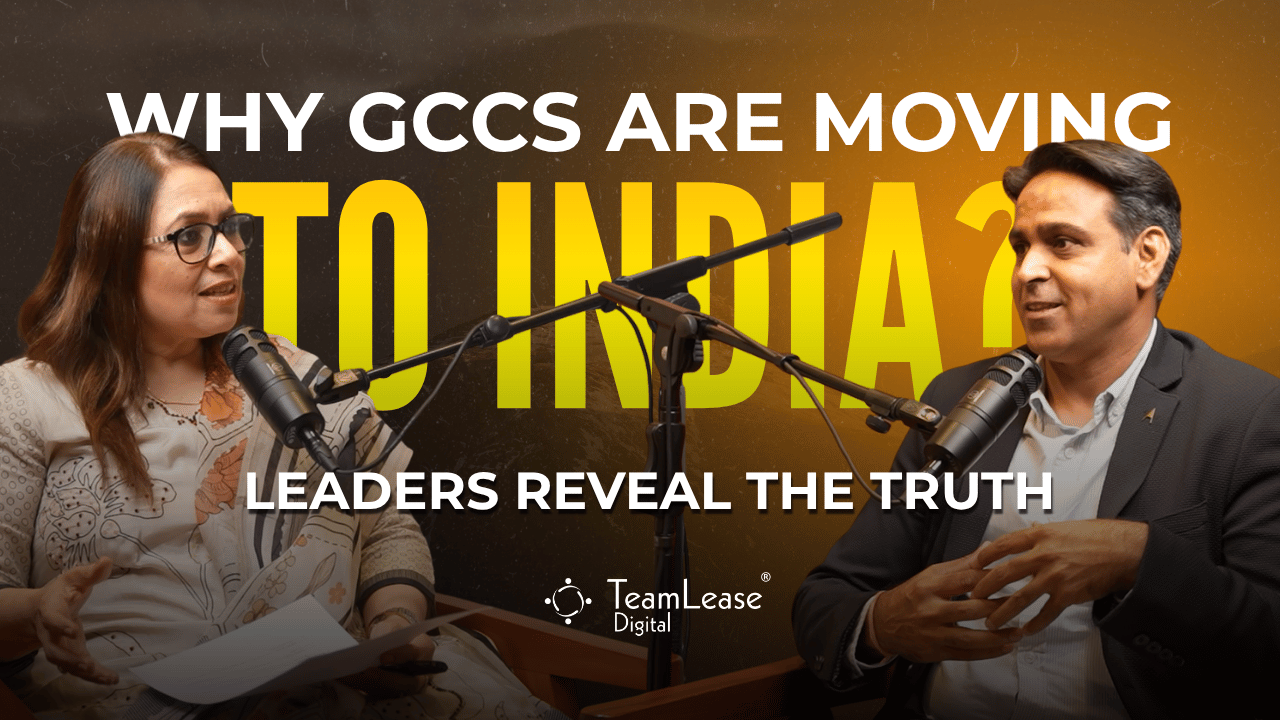
To understand how this transformation actually works inside an organization, we sat down with Alok Maheshwari, head of Festo's Global Capability Center in Bangalore, to discuss how a 100-year-old German engineering company approaches AI, talent, and the future of manufacturing innovation in India.
Watch the full conversation here:
When asked why Festo, after 40 years of primarily engineering operations in India, decided to establish a GCC focused on software and AI, Mr. Alok’s answer crystallizes the larger industry shift:
"Festo started 40 years back in India... but now Festo is a global innovation engine. They need fuel for it, and in India, we have the young talent; we have the right set of skills, which now everyone is realizing. If this growth engine of India attaches with it, then we can do far better."
This statement encapsulates what's happening across manufacturing: the recognition that innovation is no longer bounded by geography or legacy business models. India's young engineering talent, combined with its deep software ecosystem, has become strategically central to how global industrial companies innovate.
How AI Is Redefining Engineering Teams
One insight from the Festo conversation stands out: the company isn't simply hiring software developers. It's hiring for a specific intersection of skills, embedded AI (electronics + machine learning), industrial cybersecurity, and smart automation, that few companies understand how to source.
But here's what's critical: when asked about sourcing talent, the leadership emphasized something unexpected:
"I'm very hesitant to hire any person who doesn't have the basic and right communication skills... when you work in a global organization, I think your 90% problem solves with the right communication."
Why? Because GCC engineers aren't siloed technicians anymore. They collaborate across global teams, translate between hardware constraints and software possibilities, and explain trade-offs to customers. They're business partners, not just code writers.
This is the real shift. Manufacturing GCCs are hiring engineers who combine rare technical skills with the ability to think and communicate like executives. That's a rare combination, and it's exactly what manufacturing needs.
AI and the Future of Work
Perhaps the most important question Mr. Alok was asked concerned how AI would shape manufacturing work.
The response was clear: AI won't reduce headcount. It will elevate it.
"I will be more than happy if I'm generating the same work with 300 people, the value of 600 people by using the technology, rather than having 600 people doing the work of 400 people."
This is the efficiency frontier that manufacturing is pursuing. The goal isn't to eliminate engineers; it's to amplify what they can accomplish. A manufacturing engineer using AI-assisted design tools and predictive analytics can work on more complex problems faster. A production engineer monitoring AI-assisted quality systems can focus on exceptions instead of routine inspection.
The human-in-the-loop principle is standard now: use AI to handle scale and pattern recognition; use humans for judgment, creativity, and complex problem-solving. That's the collaboration model that works.
Three Principles for GCC Success
- Clarity of Intent: Successful GCCs are not built for scale alone. The real differentiator is purpose. At Festo, the GCC was designed as a value-creation and innovation hub.
- Culture by Design: Trust, ownership, and meaningful work shaped the culture. Instead of scaling headcount aggressively, the focus was on building a smaller, highly aligned team capable of driving impact.
- Leadership with Context: Understanding both global vision and local talent realities was critical. Leadership invested time in learning the parent organization’s goals while deeply engaging with India’s talent ecosystem.
The Bigger Shift
The future belongs to organizations where AI, software, and engineering are deeply embedded in business value creation, making the traditional “manufacturing vs tech company” distinction increasingly irrelevant.
The Path Forward
If you're leading a manufacturing organization, the questions are:
- Do you have the talent to build next-generation manufacturing technologies? Or are you still outsourcing that capability?
- Is your GCC a cost center or a value center? And are your hiring, compensation, and culture aligned with that intent?
- Are your best engineers asking to stay at your company? Or are they leaving for faster-moving tech firms because the work doesn't feel like the frontier?
The manufacturing companies that win the next decade will be the ones that answer these questions clearly and then build GCCs that operate as innovation centers, not service providers.
That transformation has already begun. The question is whether your organization will lead it, follow it, or be disrupted by it.
For a deeper dive into how one manufacturing GCC leader is building innovation at scale, watch the full conversation with Alok Maheshwari, head of Festo's Global Capability Center. The discussion covers talent sourcing, AI adoption strategy, culture building, and the future of work in AI-augmented manufacturing.



 OTP Login